
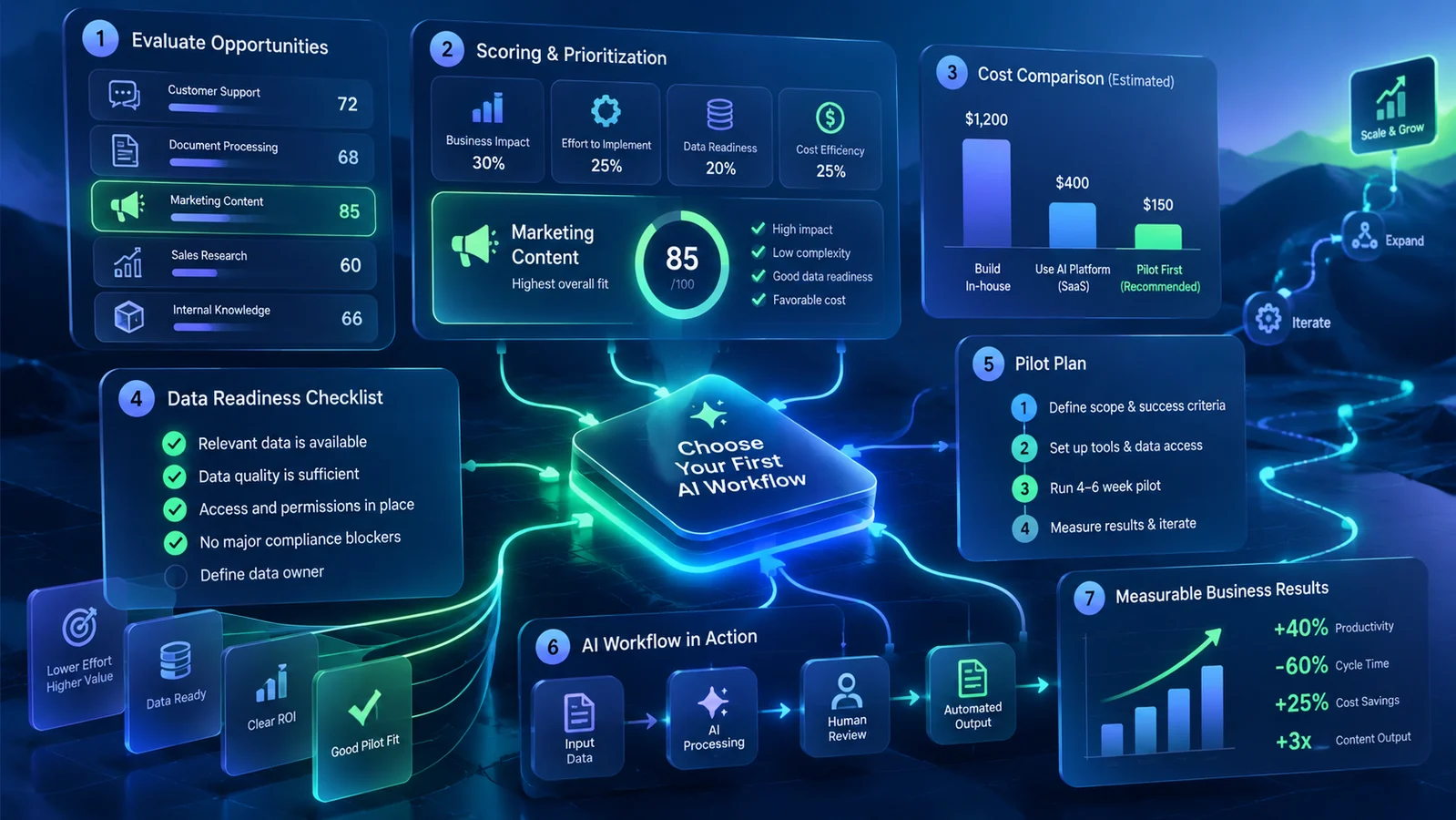
The best first AI project is usually a familiar piece of work with a clear owner, a manageable downside, and an outcome you can measure. Start with a task your team understands well enough to judge when the system is helping and when it is getting in the way.
For a small business, that might mean preparing customer replies, organizing incoming inquiries, or turning rough notes into a content draft. Choosing well requires more than spotting repetitive work. You need to understand the inputs, exceptions, permissions, review effort, and ongoing costs before deciding what to automate.
This guide walks through a practical selection process, from an initial shortlist to a small pilot. If the business has not yet prioritized its wider technology investments, begin with our practical digital strategy guide. The scoring method and worked examples below are planning tools proposed by Waldok, not industry benchmarks or promises of a particular return.
1. Define the workflow before choosing the software
“We need AI for customer service” is too broad to evaluate. “When a routine product question arrives, prepare a draft answer using our approved information and send it to the support owner for review” is specific enough to investigate. It describes a trigger, an input, an output, and a responsible person.
Write your candidate workflow in one sentence using this structure: When this happens, use these inputs to produce this output, which this person checks before this action occurs. If several departments disagree about that sentence, resolving the disagreement is part of the project. A tool cannot supply a missing business policy.
Next, walk through five recent examples with someone who does the work. Ask what they actually opened, copied, checked, and corrected. Include an awkward example, such as an incomplete inquiry or a customer asking for an exception. The purpose is to discover the real process, including informal knowledge that is absent from a written procedure.
Separate language work from ordinary rules
AI may be useful for understanding an unstructured message or preparing a readable summary. It is rarely necessary for calculating a fixed delivery charge, checking whether a required field is empty, or sending a reminder on a known date. Those steps can often use ordinary application logic around the AI component.
Our guide to AI agents vs. automation explains the distinction between fixed workflows, AI-assisted steps, and systems that choose their next action. That distinction matters when selecting a first project: a useful draft or classification task may need no autonomous agent at all.
Anthropic’s engineering guidance recommends beginning with the simplest suitable approach and adding complexity when it is justified. Its Building Effective Agents article is a useful technical reference for discussing architecture with a development team. For the business owner, the immediate decision is the job to be done and the authority needed to do it.
2. Build a shortlist and compare it consistently
Ask your team for three to five recurring tasks that create delays, repetitive effort, or avoidable rework. Keep each candidate narrow enough to observe separately. “Summarize new inquiries for the sales coordinator” is a candidate; “transform our sales operation” is a collection of projects.
Record the approximate weekly volume, current handling time, systems involved, and most common exception for each task. Also identify an owner who has time to review a pilot. A technically straightforward task can still be a poor starting point when nobody can answer questions or evaluate the results.
A simple six-factor score
Score each factor from one to five, where five means the candidate is more suitable for an initial pilot. Use the numbers to make assumptions visible rather than to create a false sense of precision:
- Frequency: five means the task occurs often enough to produce useful evidence during the pilot; one means it happens too rarely to evaluate easily.
- Business value: five means an improvement would remove a meaningful bottleneck; one means the result would have little practical effect.
- Input readiness: five means approved, current information is easy to access; one means essential information is missing or unreliable.
- Ease of review: five means a qualified person can check the result quickly; one means verifying it requires extensive investigation.
- Reversibility: five means mistakes remain private and easy to correct; one means an error could create a difficult external consequence.
- Integration simplicity: five means few systems and established access methods; one means complex permissions or fragile manual workarounds.
The maximum is 30. A higher total makes a candidate worth investigating, but serious concerns should override the arithmetic. Do not let high volume compensate for unavailable data, unclear permission to process it, or an action the business cannot safely supervise. Those are issues to resolve before a pilot starts.
Example: choosing between three candidates
Suppose a small service company considers inquiry summaries, automatic appointment changes, and monthly management reports. Inquiry summaries score well on review and reversibility because staff see the result before acting. Appointment changes might have greater apparent value but touch live commitments and depend on accurate availability. Management reports might be easy to review but occur too infrequently for a short experiment.
That company could start with summaries, preserving its existing appointment process. Another company with reliable booking interfaces and strong operational supervision might make a different choice. Document the reasons alongside the score so the decision can be revisited when the underlying conditions change.
3. Check the information and access the workflow needs
Before testing a model, identify the information a competent employee uses. For customer replies, that might include approved service descriptions, opening hours, current policies, and the original question. For an inquiry summary, it may be only the submitted message and a small set of routing definitions.
Keep the initial information set small enough for an owner to maintain. Giving a model a large folder of conflicting documents can make the workflow harder to evaluate. Decide which source takes precedence when two documents disagree, and who updates that source when the business changes.
Make a short data inventory
- Source: where each input comes from and whether it is current.
- Permission: who may access it and whether the proposed service may process it.
- Destination: where prompts, outputs, attachments, and operational logs will go.
- Retention: how long those records are needed and who manages deletion.
- Owner: who can correct the information or resolve an access problem.
Review these questions against the actual deployment and provider settings. A self-hosted application can still send selected information to an external model provider. Hosting location and model processing location are separate questions, and both belong in the project discussion.
The NIST AI RMF Playbook offers voluntary guidance organized around Govern, Map, Measure, and Manage. It can help a team structure its risk discussion. Using that guidance does not itself establish certification or prove that a particular deployment is secure.
Begin with the smallest useful set of permissions
A system preparing a summary may need permission to read a submitted inquiry, but no permission to delete customer records or send email. A reply-drafting system can be useful while a person remains responsible for sending. Write down those limits as concrete capabilities rather than relying on a general instruction to “be careful.”
Waldok’s approach to security controls treats data boundaries and human authority as design decisions. For your first workflow, describe the precise point where assistance ends and an accountable person takes over. Ensure the ordinary manual process remains available when the AI component is unavailable or uncertain.
4. Estimate the real cost, including review and maintenance
A fast draft is useful only if the overall task improves. Measure the time spent preparing inputs, reading the result, checking facts, making corrections, and resolving exceptions. Compare that complete path with the current process rather than comparing model generation time with an employee’s full handling time.
Use a simple capacity calculation: monthly volume multiplied by minutes saved per completed item, divided by 60. Then subtract the additional time required for administration, monitoring, and maintenance. Count failed or abandoned attempts too; excluding them would make the pilot look better than daily operation.
A worked planning example
Imagine a business handles 400 routine inquiries each month. The current process takes six minutes per inquiry, or 40 hours in total. In a pilot, preparing and checking an AI-assisted response takes four minutes on average across all cases, including those that need manual completion. That would leave about 26.7 hours of handling work and release about 13.3 hours.
If the new process also needs three hours of monthly maintenance and administration, the net capacity released is roughly 10.3 hours. At an illustrative internal cost of $30 per hour, that capacity is worth about $310. Subtract an assumed $90 in monthly software and usage costs, and the remaining capacity-value estimate is about $220 before setup costs.
These are hypothetical inputs, not a forecast for a Waldok product. Replace every assumption with your own observations. Staff time released is not automatically cash saved: it may become faster responses, less overtime, or capacity for other work. Only count revenue improvements when you have evidence connecting the workflow to those results.
Keep one-time expenses separate: discovery, configuration, integration, training, and migration. If implementation costs $1,500 and the measured recurring benefit is $220 per month, simple payback would be approximately seven months, assuming the benefit persists. A short pilot cannot establish that persistence, so revisit the estimate after normal operation begins.
5. Design a small pilot with a clear stopping point
A useful pilot tests a defined claim: “This workflow can prepare accurate routine inquiry summaries with less total staff effort while leaving routing decisions with the coordinator.” Decide what evidence would support or reject that claim before adjusting prompts or selecting tools.
Establish a baseline and a test set
Observe the current workflow over a representative period. Capture volume, handling time, corrections, and exceptions. If the business has weekly peaks or seasonal differences, note them rather than assuming one quiet afternoon represents normal demand.
Create a permitted set of examples that includes routine requests, missing information, contradictory details, and requests outside your service scope. Keep some examples separate from the cases used to refine the system. Testing only the examples used during development can hide weaknesses in unfamiliar situations.
Write acceptance criteria people can apply
For inquiry summaries, define required facts: the customer’s stated need, relevant dates, unanswered questions, and any request for human follow-up. Define unacceptable behavior too, such as inventing a budget, silently changing a date, or presenting an unsupported recommendation as company policy.
Record the percentage of outputs that need correction and the average review time. Separate minor wording edits from material errors. A single aggregate “accuracy” score can conceal a serious failure if it treats an incorrect appointment date the same as an awkward sentence. Business consequences should shape how you classify mistakes.
Start with staff review, then make a deliberate decision
Run the first version alongside the existing process or place its outputs in a review queue. Establish who reviews them and how corrections are recorded. A nominal human approval step is not meaningful if the reviewer lacks time, source information, or authority to reject the result.
After a predefined review point, choose among four outcomes: continue unchanged, narrow the scope, improve and retest, or stop. Stopping an unsuitable project is useful evidence. Expansion should depend on observed performance and operational readiness, including the ability to detect failures and recover without losing work.
A possible four-week schedule is one week for discovery and baseline collection, one for configuration and test preparation, one for supervised use, and one for evaluation. This is a planning example rather than a delivery promise. Low-volume workflows, difficult integrations, or sensitive information may need a different schedule.
6. Compare practical starting points with existing products
Existing software may already cover the workflow you select. Before commissioning a custom system, compare the required steps with a product’s actual capabilities, deployment requirements, and current availability. Our AI product catalog distinguishes available software from systems still being tested.
Customer reply preparation
A narrow starting point is drafting answers to a defined class of customer questions while retaining approval before sending. ReplyPilot supports AI-assisted customer email and Google Business Profile review replies with human approval. A sensible evaluation would examine factual accuracy, tone, review effort, and how unsupported questions are handled.
Keep exceptions visible. Complaints requiring a policy decision, requests for unusual commitments, or messages missing essential context may need direct staff handling. The pilot should test whether the workflow identifies those cases rather than merely producing a fluent reply to every message.
Content preparation and review
Another candidate is turning an approved brief into a draft social post. FacePrompt supports creating, reviewing, scheduling, and publishing AI-assisted Facebook content from software installed on the customer’s server. A first evaluation can focus on draft preparation and review before widening the operational scope.
Measure whether the draft reflects the brief and whether checking claims, editing tone, and selecting supporting material takes less overall effort. Generating more text is not itself the outcome. A useful content workflow helps the business produce accurate, appropriate material that someone is willing to approve.
More connected operational work
Reception, executive coordination, and catering operations may involve calendars, communications, approvals, and live records. They can offer useful opportunities, but the number of dependencies makes precise boundaries especially important. Our guide to AI receptionists for home-service businesses shows how to bound calls, qualification, booking, SMS, transfers, and human escalation. The guide to catering operations software follows the connected path from enquiry and quotation through kitchen preparation, event coordination, and dispatch. Review the current Labs development status before treating a preview as ready for general deployment.
If your selected workflow needs a tailored integration, use the custom AI delivery process to clarify requirements, validation, and handoff. The first version should prove a defined operational benefit before the system acquires more access or responsibility.
7. Write a one-page brief before the first conversation
A good brief makes a discussion more productive even when you have not chosen a model, vendor, or platform. Include the following information in plain language:
- The workflow: its trigger, inputs, output, and current owner.
- The problem: the delay, effort, or rework you want to reduce.
- The baseline: approximate volume and current handling time.
- The information: the sources available and any access restrictions.
- The boundaries: actions that require approval and work excluded from the pilot.
- The evidence: how you will evaluate quality, effort, and exceptions.
- The operating plan: reviewer, fallback process, maintenance owner, and review date.
You do not need to settle every detail before asking for help. Mark uncertainties clearly, especially when access to another system depends on its provider. Our project FAQ explains common questions about scope, integrations, hosting, and ownership. Bring real constraints into the discussion early so the proposed solution fits the business.
Common questions about a first AI workflow
Do we need a large amount of data?
You need enough relevant, permitted information to perform and evaluate the selected task. A reply-drafting workflow may begin with a small approved knowledge set and representative questions. Other tasks require much more preparation. The key is whether the information supports the specific job, not whether you can assemble a large archive.
Should the first workflow run automatically?
Some surrounding steps can, such as recording an inquiry or creating a review task. Decide separately whether an AI-generated output may trigger an external action. Keeping the first pilot in a reviewable state often makes it easier to understand errors and refine the process before granting additional authority.
What if the pilot saves very little time?
Inspect where the effort went. Poor source information, unnecessary integration, or excessive correction may explain the result. A narrower task or ordinary rules may work better. If the benefit remains small after reasonable adjustments, stop and evaluate another candidate rather than expanding an approach that has not demonstrated value.
What should we choose first?
Choose the candidate with a clear owner, usable inputs, practical review, and a measurable outcome. Prefer a scope that your team can explain and supervise. Once that workflow works reliably, use what you learned to judge the next opportunity.
Ready to make a shortlist? Tell Waldok about the workflow you want to improve, the systems it touches, and the decisions your team needs to retain. That is enough to start a grounded discussion about the next step.
Once you have selected a workflow, use our guide to AI data privacy and business control to decide what information the system may receive, how to assess third-party providers, and where stronger boundaries are needed.