
For a home-service business, the telephone is still part of the front door. A homeowner with a leaking pipe, failed heating system, damaged roof, or urgent cleaning request may call before filling out a form or sending an email. If nobody answers, the opportunity can disappear before the team finishes the job already in front of them.
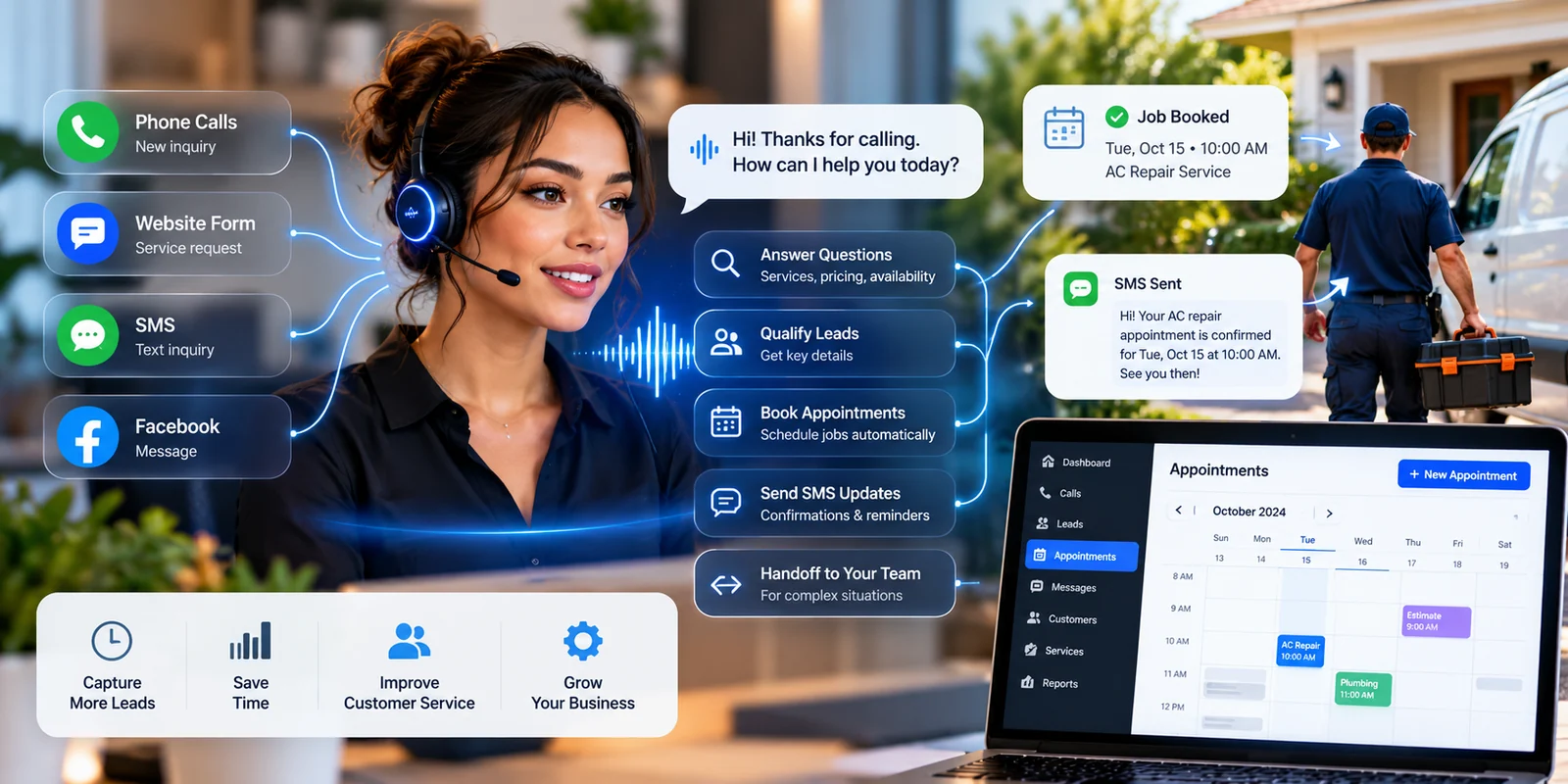
An AI receptionist can keep that front door open. It can answer an inbound call, identify why the person is calling, check approved business information, capture a lead, book an appropriate appointment, send a useful text message, or transfer the caller to a person. The goal is not to make every conversation automatic. It is to handle routine work consistently and move exceptions to the right human quickly.
This guide explains what a home-service business should automate, what should remain under human control, and how to evaluate a voice workflow in practice. It uses Waldok Receptionist as a working example because its public product site describes the complete path from the first ring to the call record.
Treat every call as an operational workflow
A business call is more than a conversation. It is the beginning of a chain of work. Someone must understand the request, decide whether the business can help, collect enough information for the next person, select an action, confirm what will happen, and preserve the result. If any stage fails, the caller may have to repeat everything or the business may never follow up.
This is why the best AI receptionist projects begin with a workflow map rather than a voice demo. A natural-sounding greeting is useful, but it is only the first few seconds. The larger question is whether the system can move a real request toward a valid outcome without inventing facts, making an unsafe promise, or trapping the caller in a loop.
Map the call types the business receives during a normal month. Separate new enquiries from existing jobs, schedule changes, supplier calls, employment questions, complaints, emergencies, spam, and requests for a named employee. Then identify the information and permitted outcome for each type. This turns “answer our phones with AI” into a set of specific jobs that can be tested.
The front desk connects several systems
A receptionist may need opening hours, service areas, trade specialties, appointment availability, escalation contacts, customer notes, and approved policies. Booking may involve a calendar. A confirmation may use SMS. A warm transfer uses the telephone network. Follow-up depends on a lead record that another person can understand.
That connected nature makes receptionist work more demanding than generating a paragraph. Our guide to choosing a first AI business workflow recommends starting with a bounded process, named owner, clear permissions, and measurable finish line. The same approach applies here: begin with a limited group of call types and actions before widening access.
What an AI receptionist can automate well
Routine inbound calls are strong candidates when the questions are predictable and the allowed actions are clear. The system can answer every configured call, greet the caller, ask why they are calling, and gather the minimum details needed to continue. It does not need to resolve every situation to be useful.
For a plumbing company, the receptionist might establish whether the caller has an active leak, the general type of property, the service address, and whether water can be isolated safely. For an HVAC company, it might distinguish maintenance from loss of heating or cooling. A cleaning company may need property size, location, preferred date, and service type. The wording changes, but the pattern is consistent.
Good automation ends in a concrete outcome
Useful outcomes include a complete lead, a confirmed appointment, a texted confirmation, a warm transfer, or a clear follow-up task. “The AI spoke to 100 callers” says little about value. “It captured 38 qualified enquiries, booked 21 valid slots, transferred six urgent calls, and created follow-up records for the remainder” is operational information.
The receptionist should be able to check approved facts such as business hours and service coverage. It can gather contact details, summarize the request, and ask a small number of conditional questions. It can then run only the tools the business has authorised. This is a practical example of the bounded-agent approach described in AI Agents vs. Automation: language helps the conversation, while rules and permissions control what can happen.
Some tasks should stay outside the automated path
Do not treat every answerable question as safe to automate. Final quotes for unusual work, liability decisions, refunds, legal threats, complex complaints, payment-card collection, safety incidents, and promises about arrival times may require a person. An AI receptionist can capture the facts and route the call without deciding the outcome.
Businesses should also decide how to handle callers who simply ask for a person. A voice system may clarify the request once so it can choose the right contact, but it should not turn access to a human into a contest. Good automation removes waiting and repetition; it does not hide the team.
Design for the caller, not the demonstration
A product demonstration usually starts with a clear voice, a quiet room, and a cooperative question. Real calls include road noise, poor mobile reception, regional accents, interruptions, children in the background, trade terminology, incomplete addresses, and callers who change direction halfway through a sentence. Caller experience must be evaluated under those conditions.
Twilio’s official ConversationRelay documentation describes live speech recognition, text-to-speech, session management, and low-latency communication with an application. It also supports interruptions during a greeting. Those capabilities make more natural voice interactions possible, but the business still has to design the conversation.
Keep the opening short and honest
The greeting should identify the business and set a clear expectation. It should not spend the caller’s patience explaining internal technology. A short disclosure that the caller is speaking with a virtual or AI receptionist can prevent confusion and helps the caller interpret pauses or clarifying questions. Local legal requirements may demand more, especially when calls are recorded or transcribed, so the deployed greeting and consent process should be reviewed for the jurisdictions involved.
Ask one question at a time. Confirm details that have operational consequences, such as a phone number, street address, appointment date, or spelling of a name. Avoid repeating every sentence back to the caller. Confirmation should reduce mistakes without making the interaction feel mechanical.
Plan for silence, interruption, and failure
The system needs rules for silence, repeated misunderstanding, connection loss, and tool failure. If the calendar cannot be reached, it should not pretend that a booking succeeded. If the caller’s address cannot be confirmed, it can capture the lead for manual follow-up. If speech recognition repeatedly fails, it should offer transfer, callback, or another contact channel.
A natural voice is not the same as a trustworthy experience. Trust comes from accurate answers, clear boundaries, useful confirmations, and graceful recovery when the technology cannot finish the task.
Qualify leads without interrogating people
Lead qualification helps the business decide whether it serves the location, performs the requested work, and has an appropriate next step. It should not become a long questionnaire that delays help. Every question should support routing, scheduling, preparation, or safety.
Start with intent: new job, existing appointment, urgent problem, quote request, or something else. Then ask only the fields needed for that path. A new job may require a service address and brief description. An existing-job call may need a booking reference or the customer’s name. An urgent request may need a safety check and immediate transfer.
Separate qualification from judgment
The receptionist can apply explicit service-area and service-type rules. It should not make speculative judgments about a caller’s value, urgency, credibility, or willingness to pay. If the business serves a postcode and handles the requested job, the system can move forward. If the situation falls outside the rules, it can create a review task rather than quietly rejecting the lead.
Review qualification outcomes for patterns. If one neighborhood, accent, request type, or call condition produces more failures, investigate the dialogue and speech recognition before assuming the callers are unsuitable. The NIST Generative AI Profile recommends structured monitoring, documentation, and appropriate human oversight because performance and risk vary by context.
Book useful appointments instead of calendar placeholders
A booking is useful only when the business can honor it and the field team has enough information to prepare. Connecting a calendar is the beginning of the workflow, not the whole design. The system must know which calendar to use, which services are bookable, appointment duration, working hours, travel buffers, lead times, coverage areas, and which requests need manual confirmation.
Google Calendar supports creating events through its official events interface. An application can create the event, but the business rules determine whether that event belongs there. The receptionist should check availability immediately before writing the booking and should report success only after the calendar confirms it.
Confirm the details that affect the visit
A strong booking confirmation includes the date, time or arrival window, service address, contact name, callback number, general job type, and any preparation the customer must complete. If exact pricing cannot be established safely on the call, say what will happen next instead of inventing a figure.
Consider whether every booking should be final. Some businesses can confirm routine maintenance immediately but need to review large installations, commercial work, restricted-access properties, warranty claims, or jobs requiring specialist equipment. The receptionist can create a pending request for those categories and tell the caller when a person will respond.
Know when and how to hand off
Human handoff is part of the product, not evidence that the automation failed. The receptionist handles volume and routine structure; people handle ambiguity, emotion, authority, and exceptions. Define the handoff conditions before the system takes live calls.
Triggers might include immediate safety concerns, active property damage, a distressed or angry caller, repeated misunderstanding, a request for a named employee, an existing dispute, a vulnerable customer, a high-value commercial enquiry, or any action outside the approved tools. Staff should be able to change these rules as the business learns.
Warm transfer needs context
A warm transfer should send the call only to an approved contact and carry enough context to avoid making the caller start again. The receiving person needs the caller’s name, reason for calling, important facts already collected, and why the transfer was triggered. If nobody accepts the call, the fallback should be clear: voicemail, a scheduled callback, another approved contact, or a captured priority lead.
Never let a language model invent a destination number. Waldok Receptionist explicitly limits transfers to approved escalation contacts. That is a small product detail with large operational value: conversational flexibility stays separate from authority over where the call goes.
Use approved knowledge and bounded actions
An AI receptionist should answer from business information that has an owner and approval state. Opening hours, service descriptions, service areas, preparation instructions, warranties, and common questions change. If the source is unclear or outdated, the voice may sound confident while giving the wrong answer.
A controlled knowledge workflow separates draft information from published information. Someone reviews a website extract or FAQ before it becomes available during live calls. The receptionist retrieves from that approved collection rather than browsing the open web or using an unpublished draft. This makes the answer easier to trace and correct.
Assign an owner to every important fact
Give each knowledge area an operational owner and review interval. Dispatch may own service coverage and hours. A service manager may own job categories and preparation instructions. Finance may own approved deposit or payment language. A manager should approve promises that affect warranties, cancellation, or customer remedies.
Versioning matters because the business needs to know which instructions governed a past call. A published configuration should remain identifiable even after new wording is introduced. Rollback should be possible when a change creates unexpected results.
Limit tools by purpose
Each connected tool should perform a defined job with the minimum permission required. Calendar access may be limited to availability and event creation on one scheduling calendar. SMS should send approved transactional messages rather than arbitrary campaigns. Transfers should use an allowlist. Lead creation should write expected fields, not modify unrelated customer records.
This control pattern is also relevant to the broader question of who controls business information used by AI. Voice automation touches customer details, transcripts, schedules, and operational knowledge. Knowing which system receives each field is more useful than treating “the AI” as one invisible box.
Create an operational record the team can use
A call should leave a useful record: caller identity when available, time, intent, collected details, outcome, booking or transfer result, and follow-up owner. A transcript can provide detail, but staff should not have to reread every conversation to find the next action.
Use a concise outcome label such as booked, qualified lead, transferred, callback required, existing-job update, outside service area, or unresolved. Show the underlying details when someone needs to investigate. This gives the team an actionable queue while preserving evidence for quality review.
Measure outcomes and corrections
Track more than call count and duration. Useful measures include answer rate, completed qualification, valid booking rate, transfer acceptance, follow-up completion, repeated questions, tool failures, caller abandonment, and staff corrections. Review a sample of both successful and unsuccessful calls.
A high booking total can hide calendar mistakes. A short average call can mean efficiency or premature disconnection. A low transfer rate can mean excellent automation or poor escalation. Pair numbers with call reviews and staff feedback before changing the workflow.
Retention should have a purpose
Transcripts and call metadata can help with follow-up, dispute resolution, training, and service improvement, but indefinite storage creates cost and privacy exposure. Decide what must be retained, why, who can access it, and when it should be deleted. Highly sensitive details should not be collected merely because a caller is willing to say them.
Handle privacy, consent, and responsibility deliberately
Voice systems involve several participants: the caller, the business, the phone provider, speech-processing services, the application, the selected language model, calendar or messaging services, and staff who view records. Document the data journey before launch. Identify where audio, transcripts, contact details, summaries, and bookings are processed or stored.
Provide an understandable privacy notice and determine what the opening disclosure must say. Recording and transcription rules vary by place and use case, so a business operating across jurisdictions should obtain advice suited to its deployment. Operational teams also need a process for access, correction, deletion, and incident handling.
Inbound calls do not provide unlimited outbound permission
A customer calling the business does not automatically authorize every future phone or text campaign. The FCC’s declaratory ruling on AI-generated voices confirms that US restrictions for artificial or prerecorded voices apply to outbound calls using AI-generated voice, including consent and identification requirements. The details depend on the call and applicable exemptions, so outbound campaigns should be reviewed separately from inbound reception.
SMS also needs a defined consent and opt-out process. Twilio’s current Messaging Policy requires prior express consent, clear sender and message-purpose information, proof of consent, and a way to withdraw it. A transactional confirmation requested during a call should remain connected to that purpose; it should not quietly become permission for unrelated marketing.
Keep responsibility with the business
The business chooses the instructions, knowledge, tool permissions, retention settings, escalation contacts, and review process. A provider may supply communication or AI infrastructure, but that does not transfer responsibility for the customer experience. Name an internal owner who can examine failures and pause or roll back a configuration.
How Waldok Receptionist approaches the workflow
Waldok Receptionist is an AI front desk for home-service businesses. Its public product information describes a workflow for cleaning, HVAC, plumbing, roofing, and general contracting businesses that depend on inbound calls.
It sits within the wider Waldok AI product catalogue, where each application is organized around a defined operational job rather than a vague promise to automate an entire company.
The application runs on a published Twilio number and uses Twilio ConversationRelay for the voice path. A realtime gateway handles the language-model turn using a published AI-agent version. This separates live speech handling from the business logic and configuration that decide what the receptionist may say or do.
Approved knowledge before live answers
FAQs and website extracts pass through a review queue. Live calls retrieve from published knowledge, rather than the open web or unapproved draft content. This supports a clear editorial boundary: staff decide which business information becomes available to callers.
Tools with defined authority
The published product workflow includes checking hours and service areas, creating leads, booking jobs on Google Calendar, sending transactional SMS, and warm-transferring calls to approved escalation contacts. The model does not receive general permission to call arbitrary numbers or take unspecified actions.
A record after the call
The dashboard records the transcript, outcome, and usage for follow-up and review. Published agent configurations use immutable snapshots, allowing operators to identify the version used during a call and roll back when necessary. The product site also describes tenant separation, retention controls, a usage ledger, and operational views for calls, leads, and SMS.
The most important point is the operating model: the AI handles routine conversation inside published knowledge and approved tools, while the business defines escalation and retains the record. Visit the Waldok Receptionist website for the current product capabilities and access options.
Plan a practical pilot
Begin with a narrow call window or call type. After-hours new enquiries may be easier to isolate than replacing the entire daytime front desk. Another option is overflow: route calls to the AI receptionist only when staff do not answer within an agreed period.
Select representative scenarios from real operations, with personal information removed where appropriate. Include easy enquiries, noisy calls, vague descriptions, interruptions, unsupported services, unavailable calendar slots, urgent situations, callers who request a person, and tool failures. A pilot that tests only perfect calls proves very little.
Define acceptance criteria before launch
- The greeting identifies the business and provides the required disclosure.
- Supported service and coverage answers match approved knowledge.
- Required lead fields are captured accurately or marked incomplete.
- Bookings use valid services, calendars, durations, buffers, and confirmation language.
- Transactional texts follow the defined consent and opt-out process.
- Transfers go only to approved contacts and include useful context.
- Safety issues, complaints, and repeated misunderstandings trigger the correct fallback.
- No tool reports success when the underlying action failed.
- Call outcomes and follow-up owners appear correctly in the dashboard.
- Staff can publish, identify, and roll back a configuration version.
Introduce the system to the team
Explain which calls the receptionist handles, when it transfers, where records appear, and who owns follow-up. Staff need a simple way to report incorrect answers, awkward phrasing, bad routing, or missing knowledge. Treat those reports as workflow evidence rather than isolated complaints.
Compare the pilot with a baseline: calls answered, qualified leads, valid bookings, missed follow-ups, staff interruptions, and customer complaints before and after. Continue only when the system improves the overall operation, including the human work created downstream.
Common questions
Does an AI receptionist replace the front-desk team?
It can absorb routine and after-hours call work, but the design should preserve human ownership of exceptions, sensitive situations, complex decisions, and customer recovery. Many businesses will use it for first response, qualification, booking, overflow, or after-hours coverage rather than for every interaction.
Can it book jobs directly?
Yes, when the service, duration, calendar, availability, service area, and booking rules are clearly configured. Requests outside those rules should become pending enquiries for a person to review.
What happens when a caller needs a person?
The workflow can warm-transfer the call to an approved escalation contact. It should pass context and have a fallback when nobody accepts, such as a priority callback record.
Where should the receptionist get its answers?
Use reviewed and published business knowledge with a named owner. Avoid live open-web answers for company policies, coverage, warranties, prices, or promises.
Should the business tell callers they are speaking with AI?
Clear disclosure supports trust and may be required depending on the location, recording or transcription practice, and type of interaction. Review the exact greeting and consent process for the jurisdictions in which the system operates.
How does this relate to email and review automation?
The channels differ, but the operating principle is similar: let AI handle repetitive preparation while keeping meaningful boundaries and human accountability. Our guide to AI-assisted emails and review replies explains that model for written customer communication.
Research references
- Waldok Receptionist: current capabilities and product access.
- Twilio: ConversationRelay technical and data-flow documentation.
- Google for Developers: creating Google Calendar events.
- NIST: Artificial Intelligence Risk Management Framework Generative AI Profile.
- US Federal Communications Commission: declaratory ruling on AI-generated voices and the TCPA.
- Twilio Messaging Policy: consent, sender identification, and opt-out requirements.
A useful AI receptionist should make the business easier to reach and easier to operate. It should answer consistently, complete approved routine actions, recognize its limits, and leave people with a clear record and next step. To see how that approach works across inbound calls, qualification, booking, SMS, transfers, and follow-up, visit Waldok Receptionist. For help mapping the workflow around your business, start a conversation with Waldok.