
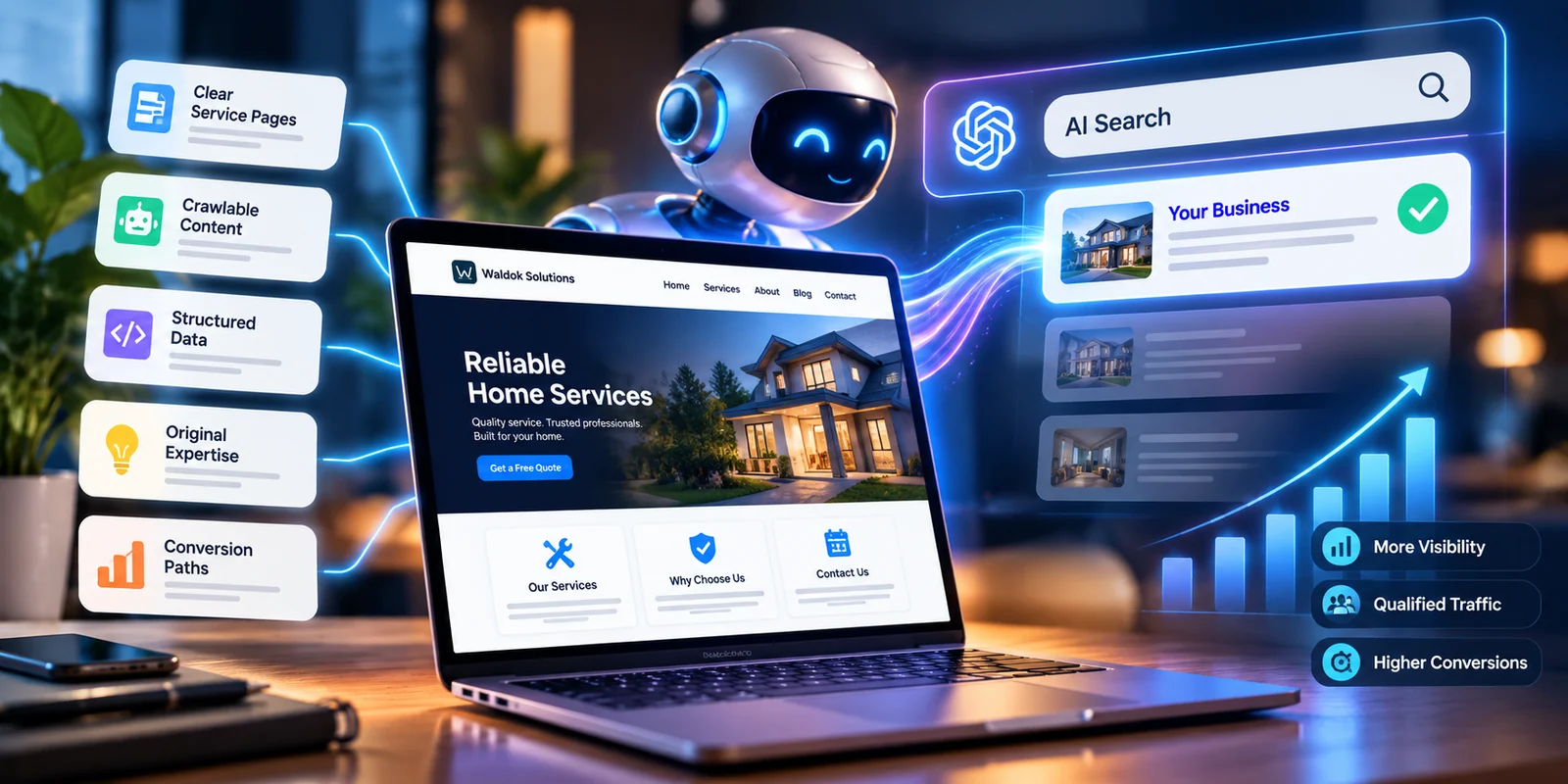
Search is changing from a list of links into a mixture of links, summaries, comparisons, maps, images, and conversational answers. That does not make the business website less important. It makes the quality of the website’s information more important because search systems need reliable pages to discover, understand, compare, and cite.
A business can appear in an AI-generated answer without receiving a click every time. It can also lose an opportunity because its website never states what the company does, who it serves, where it operates, or why its claims deserve trust. AI search readiness is therefore not a trick for inserting a brand into generated text. It is the work of making a useful business understandable to people and machines.
This guide explains how to prepare a business website for AI-powered search while strengthening conventional SEO at the same time. It covers content, crawlability, structure, evidence, accessibility, measurement, and conversion. The recommendations focus on durable fundamentals rather than promises of guaranteed citations.
What “AI search” means for a business website
AI search is a broad label for search experiences that generate or assemble an answer from multiple sources. It includes AI summaries shown above or among conventional results, conversational search modes that support follow-up questions, and assistants that retrieve pages to answer a user. These products do not all select sources in the same way, and their interfaces and reporting continue to change.
The practical change is the search journey. Someone may ask a detailed question such as “Which type of booking system is suitable for a five-person clinic with multiple locations?” rather than searching only for “booking software.” The system may break that question into related searches, compare sources, present a summary, and cite pages that support different parts of the answer.
Google’s current guide to generative AI features in Search says its established SEO practices remain relevant because features such as AI Overviews and AI Mode draw on the company’s core Search ranking and quality systems. The guide emphasizes unique, valuable, people-first content and explicitly discourages special-purpose tactics such as rewriting everything for machines, producing a page for every query variation, or assuming a new file or markup guarantees inclusion.
That distinction matters. AI search optimization is not a separate replacement for SEO. It is an extension of the same business problem: publish information that can be found, understood, trusted, and used by the right audience. A strong website supports conventional results, AI citations, maps and local discovery, social sharing, referrals, and direct visits together.
Why your website still matters when answers appear in search
An AI summary may answer an early question without a visit. That can reduce clicks for some searches. Pew Research Center analyzed the browsing activity of 900 US adults during March 2025 and found that participants clicked a conventional result in 8% of visits when an AI summary appeared, compared with 15% when one did not. Only 1% of visits to pages with an AI summary led to a cited source. The study covered Google activity from one panel and one period, so it should not be treated as a universal forecast, but it demonstrates that visibility and traffic are no longer the same measure. Read Pew’s AI summary click analysis and methodology.
The website remains valuable for the searches that carry intent. A summary can explain a concept, but a prospective customer still needs to verify the company, inspect the service, understand scope, see evidence, compare options, check location or availability, and take action. The website is where a business controls those details and the path from interest to enquiry, booking, purchase, or application.
Your site is the business’s public source of truth
A social profile, directory listing, or marketplace page can support discovery, but another company controls its layout, fields, access, and future. Your website can connect the business name to its actual services, people, policies, locations, proof, and contact methods in one coherent place. Other profiles should agree with it rather than substitute for it.
This source-of-truth role becomes more important when a search system is assembling facts. If the home page says the company serves one region, a directory lists another, and the contact page has no address or service area, uncertainty increases. If an old page advertises a discontinued service, a system or customer may still find it. AI readiness includes basic content governance: one accountable owner, consistent facts, visible update dates where useful, and a process for retiring obsolete information.
Decide which information should be public
Being understandable does not require publishing confidential methods, customer records, private pricing logic, or internal strategy. State what customers need to make a decision while keeping proprietary details inside the business boundary. Our guide to AI data privacy and business control explains how to distinguish public information from material that should not be handed to third-party systems.
First, make the important pages discoverable and indexable
Before improving a page for AI search, confirm that ordinary search crawlers can access it. A polished service description cannot be selected from an index if the crawler is blocked, the page returns an error, or the content exists only after an interaction the crawler cannot reliably perform.
Start with a short inventory of the pages that matter to the business: home, primary services or products, locations, about, evidence or case studies, contact, and important guidance. Check that each page returns a successful response, has one preferred URL, appears in the site’s navigation or contextual links, and is not unintentionally marked noindex. Use Google Search Console’s URL Inspection and Page Indexing reports and Bing Webmaster Tools rather than assuming publication equals indexing.
Give every important page a path
Google’s link best-practices documentation explains that crawlable links normally use an HTML anchor with an href. It also recommends that every important page receive a link from at least one other page. That is useful for visitors too: a service hidden behind an internal search box or an unexplained icon is hard to discover regardless of the crawler.
An XML sitemap can help search engines discover preferred URLs, particularly on new, large, or media-rich sites. It is a hint, not a ranking boost or an indexing guarantee. Internal navigation still matters because it shows relationships and gives people a route through the site.
Choose one preferred URL for each piece of content
Duplicate and near-duplicate pages dilute measurement and create uncertainty about which version should represent the information. Use redirects and canonical annotations consistently, include preferred URLs in the sitemap, and link internally to those same URLs. Consolidate old campaign pages when they no longer serve a distinct purpose. Google’s canonicalization guidance describes canonical URLs as the representative version chosen from duplicate or very similar pages.
This housekeeping is especially important during a redesign or domain migration. A new page does not inherit the history of an old URL simply because the text looks similar. Map old URLs to the most relevant new destinations, preserve meaningful content, and monitor errors after launch.
Explain the business in language a customer would use
Many business websites rely on broad phrases such as “innovative solutions,” “digital transformation,” or “excellence delivered.” Those statements may sound polished, but they do not establish what is sold, who benefits, or which problem is solved. Search systems cannot cite a fact that the website never states, and prospective customers should not have to decode the offer.
On the home page and each primary service page, answer the basics directly:
- What does the business provide?
- Who is the service or product for?
- Which problem or outcome does it address?
- Where is it available?
- How is the engagement, purchase, or delivery structured?
- What constraints, exclusions, or prerequisites should a customer know?
- What should an interested visitor do next?
A useful service page is specific enough to stand on its own. “Website development for independent professional firms” communicates more than “digital experiences.” A paragraph can then explain the type of site, the expected collaboration, the supported integrations, and what the client receives. This language benefits search without turning the page into a list of repeated keywords.
Separate services that solve different problems
If two services have different audiences, processes, evidence, or conversion paths, give them distinct pages. If they are minor variations of the same service, keep one strong page and explain the options within it. Creating dozens of thin location or keyword variations usually makes the site harder to maintain and can leave visitors unsure which page is authoritative.
Google’s AI search guide warns against manufacturing pages for every query variation or “fan-out” search in an attempt to manipulate visibility. Search systems increasingly interpret related meanings. Concentrate on a complete, useful resource with genuine distinctions rather than an inventory of near-duplicates.
Create content that contributes something original
AI can summarize information that already exists. A business earns attention by adding information that a generic summary cannot invent responsibly: first-hand experience, original measurements, a clear professional opinion, a documented process, local knowledge, current product facts, examples, limitations, and decisions made in real work.
For a service business, useful topics often come directly from sales and delivery conversations. Record the questions prospects ask before buying, the misunderstandings that delay projects, the choices customers must make, and the situations where the service is not a fit. A thoughtful answer can serve customers, support the sales team, and create a source that search systems can understand.
Move beyond generic definitions
An article titled “What Is Artificial Intelligence?” competes with thousands of broad explanations. “How a five-person property team can choose its first AI-assisted workflow” has a defined audience and decision. The value comes from the selection criteria, realistic examples, and trade-offs. The same principle applies to websites, accounting, construction, healthcare, retail, and professional services.
Use relevant evidence and link to primary sources for claims that can change or affect important decisions. Distinguish measured results from expectations. Label fictional examples and planning assumptions. If a case study describes real client work, obtain the necessary permission and state the context so readers know what the result does and does not prove.
Use AI as an assistant without publishing commodity content
AI can help outline, compare notes, find gaps, or improve structure. It cannot supply your first-hand business knowledge unless someone provides and verifies it. Google’s guidance on generative AI content focuses on accuracy, quality, and relevance and warns that producing many pages without adding value may violate its scaled-content abuse policy. The durable question is not whether software touched the draft. It is whether the finished page is correct, original, useful, and accountable.
Assign a knowledgeable reviewer. Check every factual claim, example, link, date, product detail, and recommendation. Remove passages that merely repeat the source material in different words. The reader should gain a decision, method, or perspective that justifies the page’s existence.
Structure each page so its meaning is easy to follow
Good structure helps a hurried visitor scan, helps assistive technology navigate, and gives search systems explicit relationships. Use one descriptive page title and main heading, then organize the supporting sections with logical subheadings. Put the important answer close to the question rather than forcing the reader through a long introduction.
The W3C Web Accessibility Initiative’s guidance for accessible web writing recommends informative page titles, meaningful headings, descriptive link text, text alternatives for images, and clear language. These are human benefits first. They also produce cleaner, more interpretable content than layouts where meaning is conveyed only through position, color, or visual decoration.
Use short answers inside complete pages
A page can give a direct answer in two sentences and then provide the detail needed to trust or apply it. There is no need to split every paragraph into tiny fragments for an AI system. Google says there is no required “chunking” method and no ideal page length for generative search. Choose a length that completes the reader’s task.
Lists work well for steps, requirements, and comparisons. Tables work when readers must compare the same fields across several options. Prose is better for nuance and explanation. Headings should describe the actual section rather than repeat a keyword mechanically.
Write descriptive titles and summaries
The browser title, visible heading, and page content should agree. Give every important page a distinct title and meta description that reflect its specific purpose. Google may generate a different title or snippet for a particular search, but accurate source text helps users understand the result and reduces ambiguity. A meta description is a concise invitation, not a place to repeat every service keyword.
Add structured data that matches the visible page
Structured data provides machine-readable facts about a page and may make it eligible for supported rich results. Relevant types can include Organization, LocalBusiness, Product, Article, BreadcrumbList, or JobPosting, depending on what is genuinely present. Google’s structured-data introduction explains that the markup helps classify page content.
Do not invent ratings, locations, authors, prices, or services for markup. Validate the implementation and update it when the visible content changes. There is no special structured-data type that guarantees an AI citation, and Google explicitly says structured data is not required for its generative search features. Its value is clarity and eligibility for the search features that support it.
Make identity, evidence, and accountability visible
A visitor deciding whether to contact a business looks for signs that it exists, understands the work, and will remain accountable after the sale. Search systems also benefit from consistent facts. A strong site identifies the organization, explains who is behind it, provides working contact methods, and connects claims to evidence.
Review these trust elements:
- A clear business name and concise description used consistently across the site.
- An About page that explains the company, its focus, and the people or accountable organization behind the work.
- Contact information appropriate to the business model.
- Service areas, office locations, opening hours, or availability where relevant.
- Specific product and service pages with current status and limitations.
- Case studies, demonstrations, examples, or documented methods that substantiate claims.
- Named or organizational authorship for guidance where readers would reasonably expect accountability.
- Privacy, terms, returns, delivery, accessibility, or other policies relevant to the transaction.
Google supports Organization structured data for facts such as a name, URL, logo, contact information, and real-world presence. The markup should reinforce the public information, not replace missing About and Contact pages. For eligible in-person and service-area businesses, a verified and maintained Business Profile can also keep information visible in Google Search and Maps. Our Google Business Profile and Apple Business guide explains how to maintain those records.
Once customers begin using that profile, a reliable response process becomes part of the public experience. Our guide to AI-assisted email and review replies explains how drafts, human approval, and controlled application data can support that work without turning customer communication into an unattended automation.
Show the limits of your expertise
Trust is strengthened by specificity and restraint. State which industries, regions, integrations, or project sizes you support. Explain when a service needs specialist legal, medical, financial, or security advice. A page that admits important boundaries is often more credible than one claiming to serve everyone.
Waldok’s approach to practical AI and responsible ownership is an example of using an About page to connect the company’s purpose to its way of working. The same principle applies beyond AI: explain how the business makes decisions, not only what it sells.
Performance, mobile usability, and accessibility still matter
A search appearance creates an opportunity; the page experience determines whether the visitor can use it. Test the website on real phones as well as a large monitor. Check that text remains readable, controls have adequate space, forms provide clear labels and errors, menus work by keyboard, images include appropriate alternatives, and the layout does not shift unexpectedly while someone tries to act.
For a systematic review of contrast, keyboard access, structure, images, forms, reflow, media, and ongoing testing, use our practical WCAG 2.2 guide for small-business websites.
Google’s Core Web Vitals documentation describes three field metrics: Largest Contentful Paint for loading performance, Interaction to Next Paint for responsiveness, and Cumulative Layout Shift for visual stability. Google recommends good results for search success and user experience, while also making clear that page experience is part of a much larger set of signals. A fast empty page is not useful, and excellent content should not excuse an unusable site.
Common improvements include serving properly sized images, reserving image dimensions to prevent movement, limiting unnecessary scripts, using efficient caching, loading critical content without avoidable delay, and testing third-party widgets. Measure real-user data when available because a fast office connection may hide problems experienced on mobile networks. Use our mobile-optimized website guide to test the complete journey.
Do not hide essential content behind effects
Tabs, accordions, sliders, animation, and client-side rendering can be appropriate when they improve the experience. Essential service facts and links should still exist in accessible markup and remain available when scripts are slow or an interaction is not possible. Progressive enhancement, starting with functional content and adding richer behavior, creates a more resilient site for visitors, crawlers, and browser-based agents.
Use internal links to create a coherent body of knowledge
Internal links tell a visitor where to go next and show how the business’s information fits together. A primary service page can link to a buying guide, relevant case study, FAQ, policy, and contact path. The guide can link back to the service rather than ending as an isolated article.
Use descriptive anchor text that makes sense outside the sentence. “See our website planning process” gives a clearer expectation than “click here.” Avoid inserting links on every repeated keyword or sending five neighboring phrases to different destinations. The best link answers the reader’s likely next question.
Think in topic groups:
- Core page: the definitive service, product, or capability.
- Decision content: comparisons, costs, suitability, and evaluation criteria.
- Use-case content: how the offering applies to a specific role, industry, or problem.
- Evidence: case studies, demonstrations, product status, and documented outcomes.
- Action: a relevant enquiry, booking, purchase, or application path.
This approach avoids producing disconnected articles for traffic alone. Each piece has a role in helping a visitor understand and act. Our article on choosing an AI workflow, for example, supports the wider discussion of custom systems by helping a business define its first use case before it contacts a builder.
Measure AI-search visibility and business outcomes separately
Rank tracking and organic sessions no longer describe the whole search journey. A useful measurement plan separates visibility, visits, engagement, and outcomes. A business may gain more appearances but fewer clicks for informational searches, while receiving better-qualified visits on commercial pages.
As of August 2026, Google says its dedicated Generative AI performance reports in Search Console are available worldwide. The reports cover impressions in generative features, pages, countries, devices, and dates. See Google’s Search Generative AI reporting announcement. Microsoft introduced an AI Performance public preview in Bing Webmaster Tools that reports citations, cited pages, sample grounding queries, and citation trends across supported Microsoft AI experiences. Microsoft cautions that citation counts do not describe ranking or importance within an individual answer; see the Bing AI Performance announcement.
Combine those visibility reports with website analytics and business records. Track:
- Which pages appear in generative and conventional search reports.
- Search queries and topics that expose gaps or unexpected demand.
- Organic landing pages and the actions visitors take next.
- Qualified enquiries, bookings, purchases, downloads, or applications.
- Conversion rate and lead quality by landing page or content group.
- Branded searches, direct visits, and customer mentions of where they discovered the company.
Do not claim an AI citation caused a sale unless the evidence supports that path. Search Console measures search visibility; analytics measures behavior on the site; the CRM or transaction system records the business result. Compare trends across the systems rather than forcing their totals to match.
A practical 30-day AI-search readiness plan
Week 1: establish the baseline
- List the ten to twenty pages most important to revenue, enquiries, or public understanding.
- Confirm index status, canonical URLs, response codes, mobile rendering, and analytics coverage.
- Record current conventional and generative search visibility where reporting is available.
- Identify inaccurate, duplicated, orphaned, or obsolete pages.
Week 2: clarify the business
- Rewrite the home-page introduction so it states the offer, audience, and primary outcome.
- Give each core service or product a distinct page with scope, process, evidence, limits, and next step.
- Align the business name, contact details, service area, and current availability across the site and relevant profiles.
- Improve page titles, main headings, and meta descriptions for priority pages.
Week 3: strengthen evidence and structure
- Add first-hand examples, decision criteria, original images, demonstrations, or measured results where appropriate.
- Organize long pages with descriptive headings and direct answers.
- Add or correct relevant structured data so it matches visible content.
- Connect service pages, guidance, evidence, and conversion paths with contextual internal links.
Week 4: improve experience and governance
- Fix the most consequential mobile, accessibility, and performance problems.
- Test forms, phone links, booking paths, purchases, and confirmation messages.
- Assign an owner and review date to each priority page.
- Create a monthly report that combines search visibility with qualified business outcomes.
Do not try to rebuild the entire site in a month. Complete one coherent path from discovery to action. For example: a strong service page, one supporting decision guide, one piece of evidence, and a working enquiry route. Then repeat the method for the next priority.
Common questions about websites and AI search
Do we need a separate “GEO” strategy?
You need to account for AI-generated discovery and citations, but most businesses do not need a separate website full of generative-engine tactics. Start with crawlable pages, clear services, original expertise, accurate business facts, useful structure, internal links, and measurement. Add platform-specific work only when it supports a defined audience or reporting need.
Do we need an llms.txt file?
Some services or site owners may choose to experiment with it, but it is not a substitute for accessible pages and established crawler controls. Google’s current generative-search guide says its Search systems ignore llms.txt and that the file neither improves nor harms Google visibility. Evaluate support for any other platform individually before treating it as a requirement.
Will structured data make an AI system cite our site?
No supported markup guarantees a citation. Structured data can clarify page entities and make content eligible for specific rich results when it follows the relevant rules. Add accurate markup that matches visible content, but invest first in the page’s usefulness and evidence.
Should every article be at least 2,000 words?
No universal word count determines quality or AI visibility. A pricing definition may need a few paragraphs; a complex buying guide may need several thousand words. Finish the reader’s task without padding. This article is long because it combines strategy, implementation, measurement, and a plan.
Can we use AI to write website content?
Yes, as an assistive tool, provided a knowledgeable person supplies the real insight and verifies the result. Do not publish invented experience, fabricated sources, inaccurate services, or large volumes of interchangeable pages. The business remains accountable for what appears under its name.
How quickly will changes affect AI search?
There is no reliable universal timeline. Crawlers must revisit the page, systems must process it, and the content must be relevant to actual searches. Technical fixes may be recognized before visibility changes. Monitor indexing and impressions over weeks and months, and judge the work by qualified outcomes rather than a single test query.
Research references and further reading
- Google Search Central: optimizing for generative AI features.
- Pew Research Center: clicks when Google AI summaries appear.
- Bing Webmaster Blog: AI Performance reporting.
- Google Search Central: Generative AI performance reports.
- Google Search Central: helpful, reliable, people-first content.
- Google Search Central: structured data fundamentals.
- Google Search Central: Core Web Vitals.
- W3C Web Accessibility Initiative: writing for web accessibility.
The goal is not to redesign a website for an algorithm. It is to make the business easier to find, understand, trust, and choose wherever discovery begins. If your site does not yet provide that path, the Waldok delivery process can turn the business requirements into a maintainable web or AI-enabled system. You can also share the current website and desired outcome with Waldok.